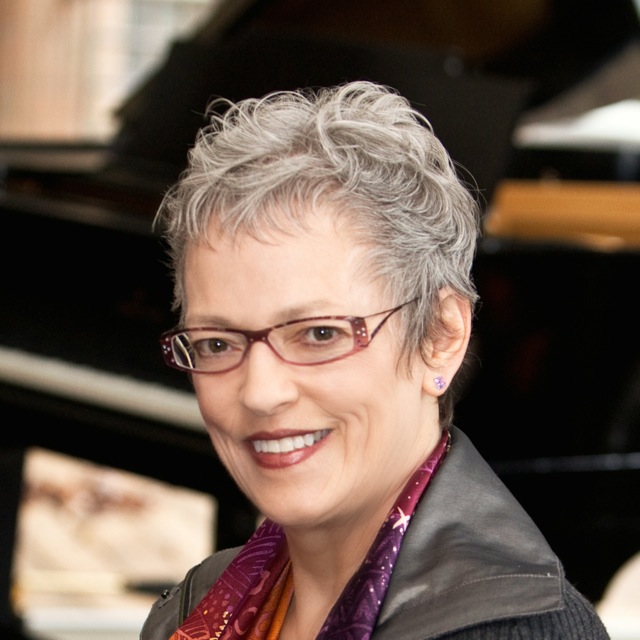
cindy mctee
narrative biography
Cindy McTee was born in 1953 in Tacoma, Washington and raised in the nearby town of Eatonville. The daughter of musical parents (her father played trumpet and her mother played clarinet), McTee often went to rehearsals of their small dance band where she heard popular music and jazz from the 1940's and 1950's. McTee began piano studies at the age of six with a teacher who encouraged improvisation (the beginnings of her career as a composer) and she began studying saxophone with her mother a few years later.
Another important influence on her musical life was the eminent Polish composer, Krzysztof Penderecki, whom she met in 1974 while majoring in composition at Pacific Lutheran University in Tacoma. Penderecki invited McTee to teach his children English in exchange for composition lessons. She accepted the invitation and spent an entire year in Poland living with the Penderecki family and studying orchestration, twentieth-century composition techniques and counterpoint at the Cracow Academy of Music. Lessons with Penderecki were conducted informally, generally at the family dining room table. She also worked with Marek Stachowski and Krystyna Moszumanska-Nazar while in Poland.
McTee studied with David Robbins and Thomas Clark at Pacific Lutheran University (BM 1975), with Jacob Druckman and Bruce MacCombie at the Yale School of Music (MM 1978), and with Richard Hervig at the University of Iowa (PhD 1981).
McTee taught for three years at her undergraduate alma mater in Tacoma, Washington, and in 1984 joined the faculty of the University of North Texas, receiving promotion to Full Professor in 1995 and to Regents Professor in 2000. In 2009, she was designated a Fellow in UNT's Institute for the Advancement of the Arts. She also participated in leadership roles at UNT, most notably as Chair of the Division of Composition Studies for a total of five years ending in 2000.
In May of 2011, she retired from the University of North Texas as Regents Professor Emerita, and in November of 2011 she married conductor, Leonard Slatkin. Their principal place of residence is in Saint Louis, Missouri.
Ms. McTee has received numerous awards for her music, most significantly: a Guggenheim Fellowship, a Fulbright Fellowship, a Composers Fellowship from the National Endowment for the Arts, two awards from the American Academy of Arts and Letters, a Music Alive Award from Meet The Composer and the League of American Orchestras, the Detroit Symphony Orchestra's Elaine Lebenbom Memorial Award, and a BMI Student Composers Award. She was also winner of the 2001 Louisville Orchestra Composition Competition.
She has been commissioned by the Detroit Symphony Orchestra (2009-10), Leonard Slatkin, music director; the Houston Symphony Orchestra (2007), Hans Graf, music director; wind ensemble consortia (2007, 2001); the Amarillo Symphony Orchestra (2006), James Setapen, music director; the Dallas Symphony Orchestra (2005 and 2000), Andrew Litton, music director; Bands of America (2004), Eugene Migliaro Corporon, conductor; the National Symphony Orchestra (2002), Leonard Slatkin, music director; the Big Eight Band Directors Association (1995); the American Guild of Organists (1993); the Barlow Endowment (1993); the College Band Directors National Association, Western and Northwestern Divisions (1993); and the Pi Kappa Lambda Board of Regents (1991).
Hailed by the Houston Chronicle as a composer whose music reflects a charging, churning celebration of the musical and cultural energy of modern-day America, Cindy McTee brings to the world of concert music a fresh and imaginative voice.
The Washington Post likewise characterized her work as unmistakably American-sounding, composed with craftsmanship and a catholic array of influences across several centuries. There’s also a polished gleam about her colors, according to the Detroit Free Press, as well as an inventive approach to form and a respect for tradition.
The works of Cindy McTee have received performances by leading ensembles in important venues throughout the world, including Carnegie Hall on five separate occasions. Among the many ensembles to have performed her music are: the Aspen Festival Orchestra, the Berner Symphonieorchester, the Boulder Symphony, the Chamber Music Society of St. Louis, the Cleveland Orchestra, the Eastman Wind Ensemble, the Finnish Radio Symphony Orchestra, the Hong Kong Sinfonietta, London's Philharmonia Orchestra, the Lone Star Wind Orchestra, the Los Angeles Philharmonic, the Louisville Orchestra, the Maryland Symphony, the National Repertory Orchestra, the National Symphony Orchestra, the New World Symphony, the North Texas and Dallas Wind Symphonies, The Orchestra Now, the Orchestre National de Lyon, the Orchestre Philharmonique de Monte-Carlo, the Orquestra Simfonica Illes Balears, the Pacific Symphony, the Philadelphia Orchestra, the Pittsburgh New Music Ensemble, the President's Own U.S. Marine Band, the RTE National Symphony Orchestra (Dublin), the Showa Wind Symphony, Tokyo's NHK Symphony Orchestra, the United States Army Field Band, the United States Coast Guard Band, the United States Navy Band, Voices of Change, the Washington Metropolitan Philharmonic, the Philharmonic Orchestras of Buffalo, China, Helsinki, Moscow, Rhode Island, and Rochester, as well as the Symphony Orchestras of Baltimore, Bern, Billings, Boston, Charleston, Chicago, Colorado, Columbus, Dallas, Detroit, Flagstaff, Ft. Worth, Hartford, Hawaii, Houston, Indianapolis, Nashville, Novosibirsk, Omaha, Pittsburgh, Puerto Rico, San Antonio, Seattle, Shanghai, St. Louis, Toronto, and Sydney.
In A Composer's Insight: Thoughts, Analysis and Commentary on Contemporary Masterpieces for Wind Band (Timothy Salzman, editor), David Fullmer writes the following:
"A description of McTee’s compositional style would include humor; expectation denied; unexpected silences and rhythmic displacement; jazz textures; post minimalism. She believes, as Stravinsky, that music either sings or it dances. She characterizes her music as intentionally playful and humorous.
'As far as specific musical influences are concerned, I can say that my current interest in expressing humor through music may be attributable to Penderecki. When thinking of Penderecki's music, most people probably recall Threnody, the St. Luke Passion, the Dies Irae, and other solemn works. However, there are also several capriccio's and a comic opera. I think Penderecki may have given me the courage to break away from the notion that modern music need always express serious modes of thinking and feeling.'
Structurally her music embraces traditional forms that are unified through unrelenting chains of ostinati which, via clever asymmetrical variations, run counter to predictable strong beat/weak beat relationships. Those variations in typical accent structures draw the listener into a deeper mode of concentration, as one is never sure where the next rhythmic displacement will occur.
There is a pervasive jazz influence in her music rhythmically, harmonically and melodically. Her technically complex melodic fragments comprised of a step-wise chromaticism as well as disjunct leaps are clearly references to the be-bop jazz era. Rhythmically, many of those melodic fragments conclude on an offbeat and are frequently broken up by brief, syncopated tutti statements. Driving bass lines, snare drum rim shots and the use of ride cymbal and hi-hat percussive effects are also hallmarks of her composition's jazz textures."Cindy's extra-musical activities have included mountain climbing, hiking, downhill skiing, amateur car racing, ballroom dancing, photography, and language study.
(Updated 10.9.22)